Real Risks and Critical Points Encountered in PAM Projects in the Field
In corporate environments, Privileged Access Management (PAM) projects are generally positioned as a critical component of the security architecture. However, field experience shows that technical deployment alone does not necessarily mean success. PAM projects are often designed within a technically correct framework. The architecture is planned, the product is positioned, integrations are implemented, and the system is deployed. Yet real-world experience demonstrates that success cannot be measured solely by technical accuracy. In PAM projects, the challenges usually arise not from technology, but from people and processes:
Lack of coordination between teams
Unclear or undefined expectations
Insufficient ownership of the process
Based on the field experience gained through the projects we conduct at Natica, this article addresses the areas where PAM projects most commonly struggle and the misconceptions that often arise during implementation.
Technical Deployment Is Successful, What Happens Next?

Directly failed installations in PAM projects are rare. In most projects, the system is technically operational. However, it is quite common that the expected impact does not materialize after the transition to the live environment.
The clearest observation from the field is this:
“Failure is often not caused by the product, but by expectation management.”
If the customer’s needs are not clearly analyzed or if the product’s boundaries are not properly defined, the project becomes fragile. A structure that appears to function smoothly during the testing phase (POC) may struggle within the complexity of the real environment. Additionally, incorrect sequencing of project steps or skipping a critical step can force the process to start over. For this reason, potential rollback and backup scenarios should be planned from the beginning of the project.
“It is sometimes necessary to restart the project from the beginning because a backbone step was skipped.”
Failures in PAM projects are not always caused by the customer side. Incorrectly designed project phases, failure to plan rollback scenarios at the beginning, and incomplete dependency analysis are risks that may originate from the consulting side as well.
For this reason, in PAM projects the question should not only be “what will we implement?” but also “what could go wrong?”
Human Factor and Team Alignment
In the field, problems that appear technically complex are often caused by communication issues between teams.
“I knew the problem, I knew the solution. But the hardest part was not technical, it was managing the customer.”
PAM projects affect multiple teams. Security, system, network, and application teams are all part of the process. However, each team may not anticipate that a change they make could impact PAM.
One of the most common situations experienced by experts is the following:
“In environments where it is said that no changes were made, a team-related change almost always appears during root cause analysis.”
The statement “nothing has changed” is often not technical; it usually indicates a lack of proper change management. For PAM to remain sustainable, infrastructure changes must be visible, traceable, and controlled.
Organizational Authority and the Reality of the PAM Administrator
A PAM system that is technically implemented correctly cannot remain sustainable if it is not supported organizationally.
“The person who should enforce the restriction becomes powerless in that environment and ends up saying ‘okay, go ahead.’”
At this point, PAM exists on paper but is effectively bypassed in practice. PAM projects that lack executive support tend to weaken over time. If the authority responsible for enforcing the process is not clearly defined, bypass behavior becomes inevitable.
Mispositioning and Expectation Problems
PAM is not simply a product; it is a concept. Different vendors’ solutions may address the same need through different approaches. However, a common situation encountered in the field is that organizations expect the exact same behavior from a new platform based on their experience with a previous product.
Each product may deliver similar capabilities through different workflows. If these differences are not clearly explained, unnecessary comparisons and expectation conflicts may arise.
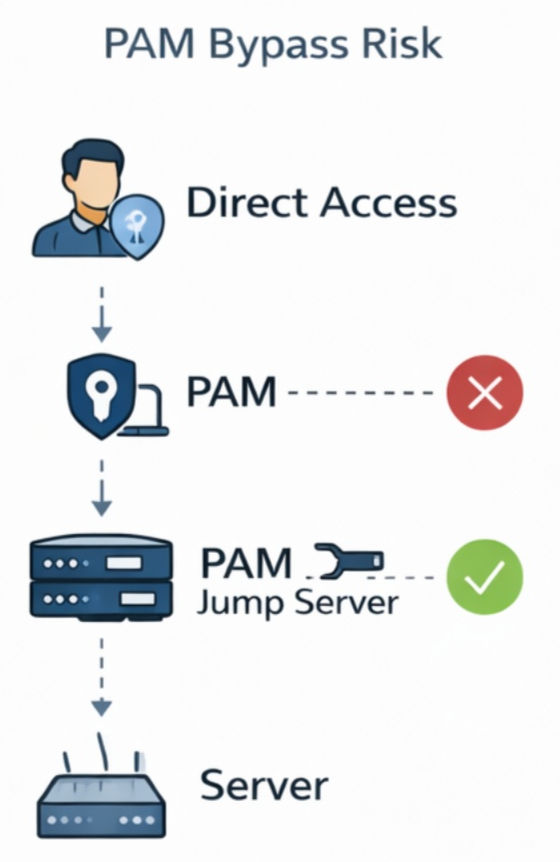
Mispositioning does not only occur in product expectations but also in the usage approach. If the balance between speed and security is not properly established, processes may move outside of PAM even when it is deployed.
“Let’s not retrieve it from the vault just this once.”
This mindset often begins as an exception but can easily turn into a habit.
If all privileged access does not pass through PAM, the system may technically be working, but from a security perspective it is not fully functioning.
Comfort of Habit and Resistance
The most common objection from operations teams is the disruption of established habits.
“I used to do this with two clicks.”
New interfaces, additional steps, and approval processes may initially create resistance. This resistance is usually not a reaction against security itself, but rather against the disruption of familiar workflows.
A security process may exist on paper, but in practice it may be bypassed.
“When users avoid using PAM, the reason is usually not security concerns, but habit.”
These seemingly small resistances can eventually evolve into permanent bypass behavior.
Unsupported Applications and Hidden Operational Load
Another real-world challenge is that not all applications are natively supported by PAM solutions.
“In cases where Secret Server does not provide native support, we have to write scripts for third-party applications.”
While this can be solved technically, it may create operational overhead if sustainability is not considered.
PAM projects in which integration costs and ownership are not defined from the beginning tend to slow down in later phases.
Hidden Risks in Service Accounts and Shared Accounts

One of the most commonly neglected areas in the field is service account management. In many organizations, priority is given to end-user accounts while service accounts running in the background are overlooked.
“The service is running, let’s not touch it” is one of the most risky approaches.
These continuously running and highly privileged accounts pose significant risks. Additionally, unnecessary access permissions in shared accounts, overly broad sharing groups, or inactive session recording can weaken accountability.
Audit logs may show that access occurred, but if session recording is not enabled, the actions performed during the session remain invisible.
In modern environments, the risk is not limited to user accounts. CI/CD credentials, API tokens, and machine identities must also be included within the scope of PAM.
Service account management remains incomplete without automated password rotation and proper dependency analysis.
What PAM Actually Solves and What It Does Not
One of the most common misconceptions encountered in the field is the belief that PAM will solve all security problems. In reality, PAM has a very clear focus: controlling privileged access.
PAM answers the question of who accessed which privileged account, when, and under what conditions. It limits account sharing, makes sessions visible, and reduces uncontrolled use of privileges. It also plays a significant role in minimizing local administrator risks.
However, PAM does not represent the entirety of security. It does not perform event correlation, threat hunting, or malicious behavior analysis. It does not replace SIEM, EDR, or network security solutions.
“PAM does not perform log management; it is not a SIEM.”
“I am not an EDR, I cannot behave like an antivirus.”
PAM is a layer of the security architecture, not the entire architecture.
PAM Maturity: Beyond Deployment
PAM deployment and PAM maturity are not the same thing. In many organizations, PAM products have been implemented, but processes often remain at early maturity levels. Moving privileged accounts into a vault is an important step, but real maturity is achieved when session recordings are enabled, local administrator privileges are minimized, service accounts are managed automatically, and DevOps integrations are established within modern architectures.
Conclusion: Process Is as Critical as Technology
Field experience clearly shows that the success of PAM projects is directly related to how the process is managed. Achieving real value from PAM requires clearly defined expectations and an actively maintained process.
At Natica, our approach is to treat PAM not merely as a product deployment, but as a sustainable security discipline. Because in PAM projects, the real difference is created not by technology, but by process and ownership.


