SSE and SASE: The Transition from Traditional Security to Next-Generation Web Security
1. What Are SSE & SASE?
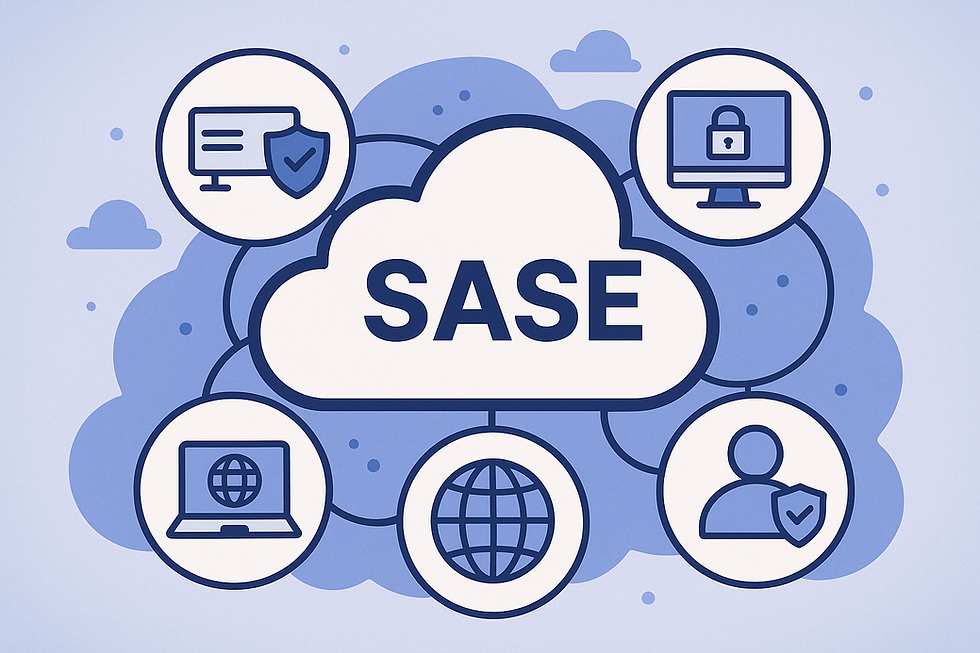
Secure Service Edge (SSE) and Secure Access Service Edge (SASE) are cloud-based security architectures designed to provide users with secure access to the internet and cloud applications.
SSE continuously monitors and protects web traffic, SaaS, and private cloud applications, while preventing risks such as data loss, malware, and unauthorized access. By consolidating security services such as SWG, CASB, DLP, ZTNA, and Threat Protection into a single platform, it enables users to work securely and seamlessly from anywhere.
2. What Challenges Do Traditional Web Security Architectures Create?
For a long time, traditional VPN solutions were the most logical and widely preferred method for employees to access corporate resources. For many years, the applications and services users needed were hosted behind corporate data centers.
However, the situation has changed significantly today. A large portion of the applications used by organizations and users has moved to the cloud and is now accessible over the internet. Routing user traffic through a VPN back to the corporate data center to access these resources has led to increased latency, network bottlenecks, performance issues, and a poor user experience.
In addition, the rapid growth of cloud and SaaS applications, along with the shift toward remote and hybrid work models, has significantly increased demand. Scaling traditional security infrastructures to meet this demand not only increases operational complexity but also drives up costs.
Considering all these factors, it is clear that traditional approaches are no longer sufficient to meet modern requirements and do not provide a sustainable solution.
3. How Can Organizations Protect Web Security with SSE & SASE?
Today, a significant portion of web traffic occurs through applications and cloud services. We also know that a considerable amount of malware now spreads via cloud applications. At the same time, users can work from home, the office, or anywhere in the world, and corporate data is no longer confined to a single data center but distributed across multiple environments.
For this reason, user internet access must be continuously, seamlessly, and contextually inspected.
SSE solutions provide end-to-end visibility and protection by consolidating security components such as SWG, CASB, DLP, ZTNA, SSL Inspection, Threat Protection, and SD-WAN into a single platform.
Thanks to this unified structure, organizations can centrally control web and cloud traffic and prevent sensitive data leakage. In addition, managing all security policies from a single point and through a single agent/client enhances security while reducing operational complexity and delivering a more optimized architecture in terms of performance.
4. What Developments Can We Expect in the SSE & SASE Landscape in the Near Future?
SSE is evolving beyond being just a security layer and is set to become the digital nervous system of organizations by 2026 and beyond.
One of the most significant drivers of this transformation, beyond the widespread adoption of cloud applications, is the rise of Generative AI technologies, which are rapidly becoming central to everyday operations. Today, organizations worldwide are either actively using multiple Generative AI applications or are compelled to adopt them.
This shift indicates that Shadow AI will become a much more critical issue in the near future. What data employees share with AI tools, what data they receive, and whether sensitive corporate information is being exposed to these platforms will become a central security concern.
At the same time, AI capabilities developed by SSE vendors will enable the detection of malicious activities, making these processes far more proactive and autonomous.
5. What Does Natica Do in the SSE & SASE Field?
At Natica, our goal is to accurately identify the needs of organizations, provide them with the most suitable security solutions, and guide them through the transition to next-generation web security architectures.